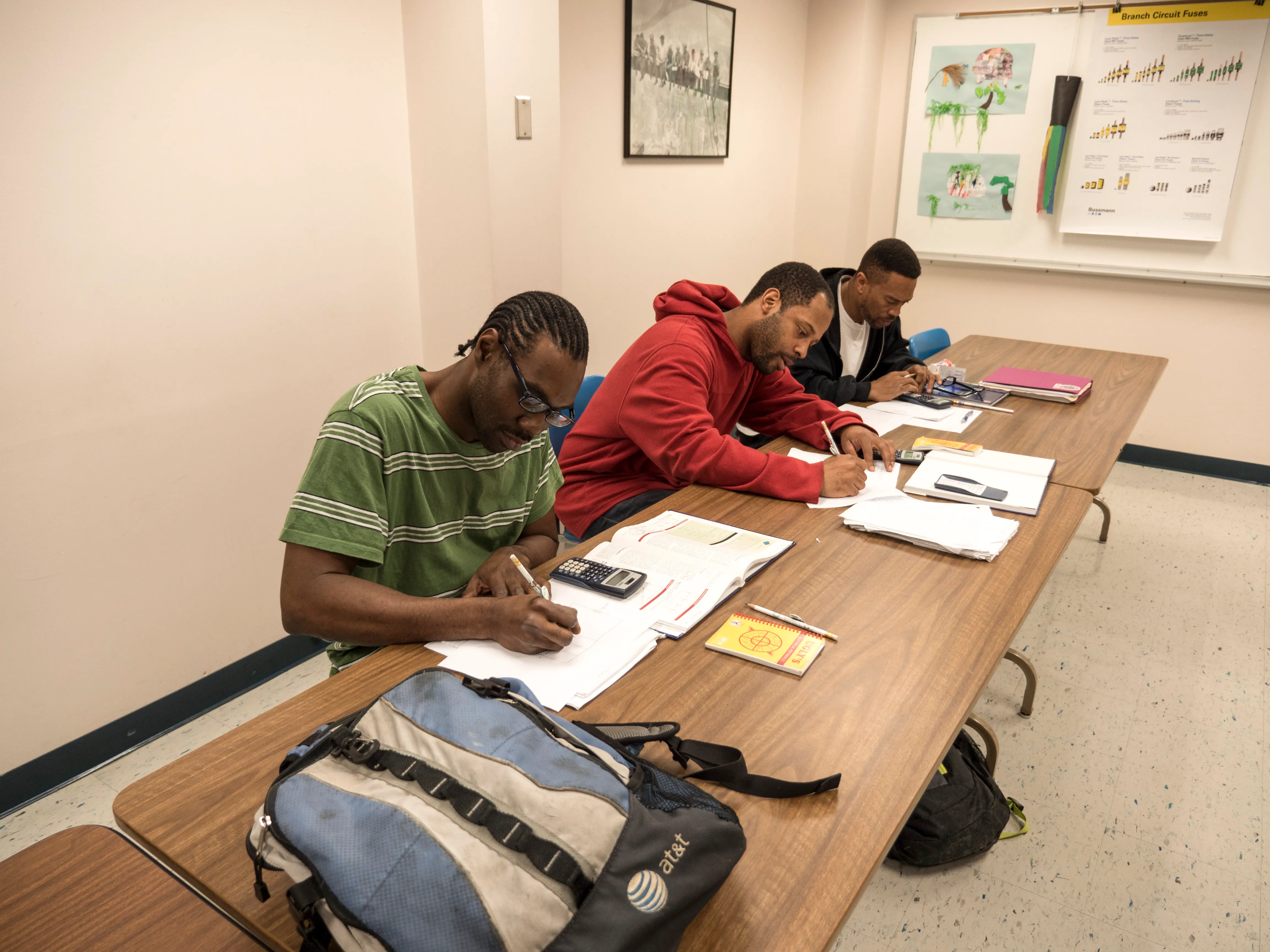
Tech Math
Reviews the basic math skills required for electrical and electronic work — algebra, geometry, and applied problem-solving for the trade.
16 sessions
Suggested prerequisite for many courses
 IBEW Local #1 · St. Louis Chapter NECA · Electrical Connection® Partnership
(314) 644-3587
2300 Hampton Ave., St. Louis
IBEW Local #1 · St. Louis Chapter NECA · Electrical Connection® Partnership
(314) 644-3587
2300 Hampton Ave., St. Louis
Continuing Education · Night School
The Electrical Industry Training Center runs night-school classes for IBEW Local #1 journeymen and apprentices. Below is the current course catalog.
Catalog overview
Classes are sequenced so journeymen and apprentices can build skills progressively. Tech Math, DC Theory, and AC Theory are the foundation — most technical courses assume you have completed (or are working through) those. Computer/tablet access and a current email address are required for any course flagged for online homework.
Track 1
Suggested prerequisites for many of the technical courses below — start here if you have been out of the apprenticeship for a while.
Reviews the basic math skills required for electrical and electronic work — algebra, geometry, and applied problem-solving for the trade.
Suggested prerequisite for many courses
Fundamentals of electricity and DC circuits: Ohm's law and the relationship of voltage, current, resistance and power. Covers parallel and combination circuits, magnetism, and generators.
Requires email + computer/tablet for homework
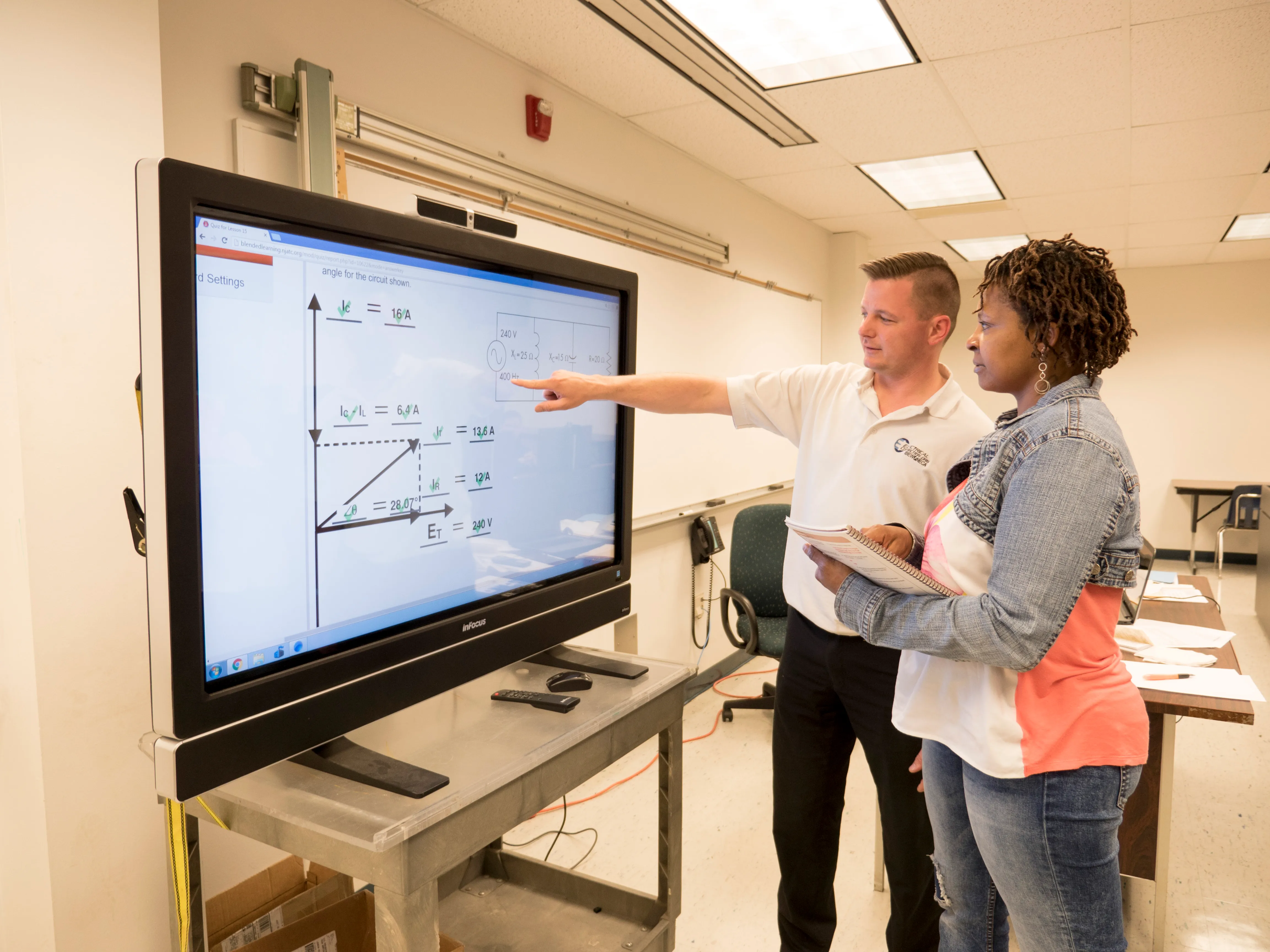
Builds on DC Theory. Inductive reactance, capacitive reactance, impedance, power factor, plus delta and wye configurations. A solid review for journeymen returning to study.
Requires email + computer/tablet for homework
Track 2
Code update, NEC mastery, OSHA, NFPA 70E, and First Aid/CPR — the credentials our contractors expect every journeyman to maintain.
Builds the foundational skills for using the National Electrical Code as a working tool — identifying key words, phrases, and structure before tackling the full NEC course.
2023 NEC code book required
Detailed course in the use, interpretation, and application of the NEC. Prepares the student for licensing exams.
2023 NEC code book required
OSHA electrical safety requirements and NFPA 70E. Covers safe work practices, arc-flash PPE selection, and techniques to reduce or eliminate electrical hazards.
Industry-specific 10-hour OSHA safety course covering the CFR, hazard recognition, and prevention on construction sites. Earns OSHA certification.
Must attend all sessions for certification
Industry-specific 30-hour OSHA course on jobsite safety, the CFR, and OSHA policies & procedures, with one night devoted to NFPA 70E.
Must attend all sessions for certification
Meets OSHA First Aid guidelines. Combines lecture, interactive video, and hands-on lifesaving skills practice for workplace emergencies.
2-year certification · requires email + computer/tablet
Track 3
Lab-heavy courses in conduit bending, motor controls, transformers, splicing, welding, rigging, and robotic layout. Most of your time is on the tools.
Minimum 18 hours of classroom + 18 hours in the bending lab. Hand benders, mechanical benders, segment and concentric bending fundamentals.
Manual and automatic control devices, control diagrams and drawings, timing devices, and troubleshooting principles. Industrial control circuits and schematic interpretation.
Requires email + computer/tablet for homework
Transformer theory and the relevant NEC articles, with hands-on time in the transformer lab. Helps prepare students for the journeyman electrician exam.
2023 NEC code book required
Cable, tools, and materials for medium-to-high voltage work (2,000–35,000 V). Intensive hands-on lab where every participant builds 5 kV and 15 kV taped straight splices and terminations, plus an introduction to taped "tee" splices.
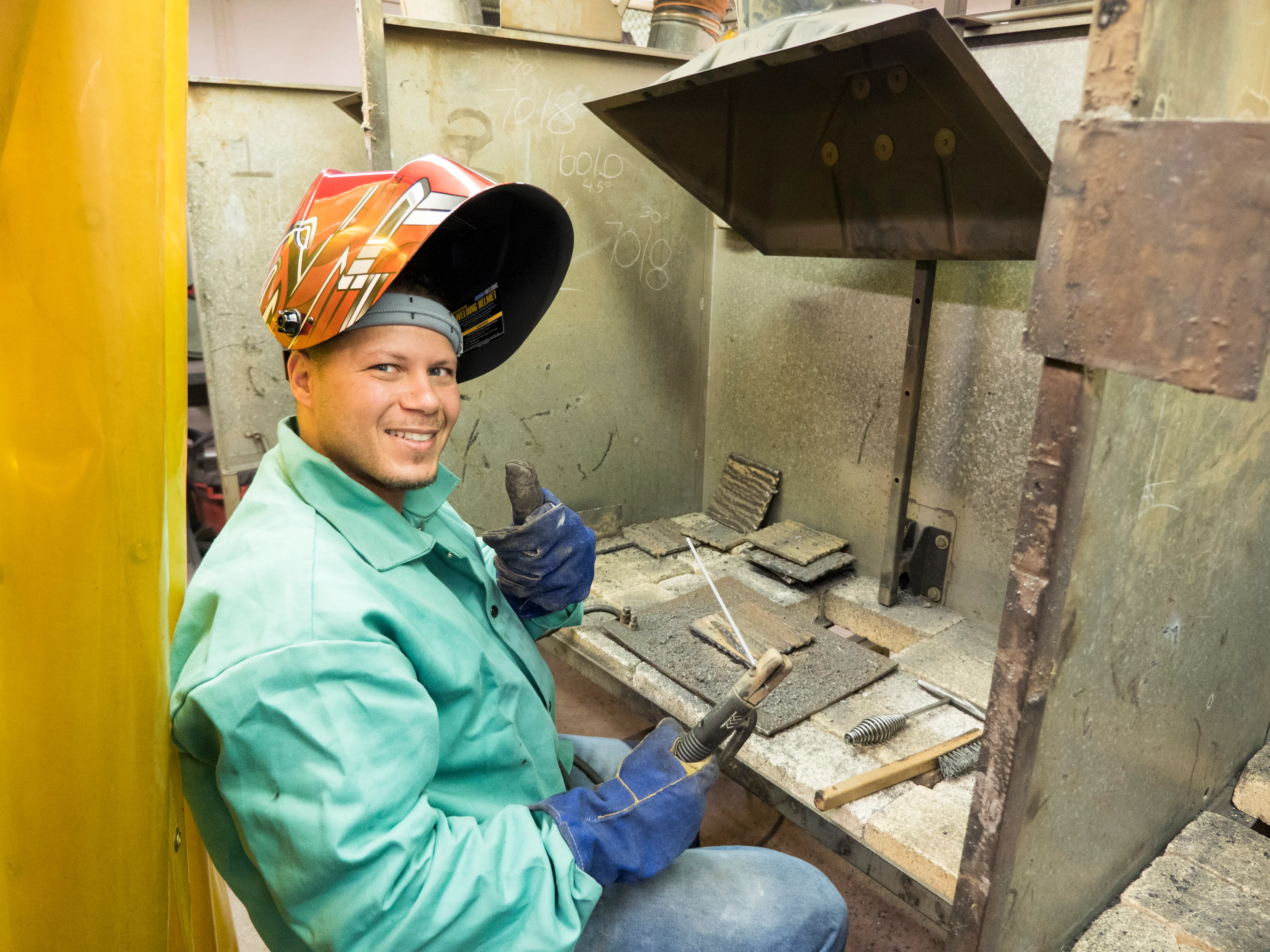
Introduction to the welding skills needed in today's job market. After a brief intro to terminology and equipment, most of the class time is in the welding lab.
Equipment, calculations, and procedures for safe handling and transport of materials by hoist or crane — including the effect of rigging arrangements on sling and line loads.
Robotic Total Station setup, control points, electrical-point layout, and field-condition capture for layout of duct banks, conduits, hangers, and fixtures.
Track 4
Process-control instrumentation training — measuring pressure, temperature, flow, and liquid level, plus loop-checking and tuning.
Skills required to install and calibrate instruments used for process-control applications — pressure, temperature, flow, and liquid-level measurement.
Prep course for the Level A examination · requires email + computer/tablet
Loop check, troubleshooting, maintenance, and fine-tuning of process-control systems. Digital protocols, control-valve specs, and fluid characteristics.
Track 5
Practical air conditioning and refrigeration training — the foundation electricians need to work alongside the mechanical trades.
Practical AC/refrigeration: installation, maintenance, diagnosis, and repair. Prepares the student for the EPA Certification Test.
Hands-on installation, maintenance, and troubleshooting of HVAC systems, including EPA recovery requirements.
Track 6
Networking, structured cabling, fiber, fire alarm, and security/access — the systems that make modern buildings work.
Fundamental networking knowledge — topologies, OSI model, network protocols, wireless technologies, basic wiring. IP and MAC addressing in network-based systems.
Requires email + computer/tablet for homework
How computer systems operate and the structured-cabling backbone that connects them.
Requires email + computer/tablet for homework
Theory and principles of fiber-optic technology, signal transmission, OTDR usage, and Unicam connector installation.
Requires email + computer/tablet for homework
Codes and standards for fire-alarm systems, initiating devices and notification appliances, wiring, and integrity monitoring. Hands-on installation, addressing, and troubleshooting of addressable systems.
Requires email + computer/tablet for homework
Intrusion detection and access-control systems — building codes, wiring panels, device installation, and troubleshooting.
Requires email + computer/tablet for homework
From CW to journeyman
Organized members and CW (commercial wireman) apprentices have a defined pathway to the IBEW-NECA Inside Journeyman Wireman classification. Probationary period (2,000 hr) → CW Apprenticeship Craft Certification (10,000 hr) → Commercial Wireman at 70% JW rate → optional 4 core classes + 16,000 total hours to reach Inside Journeyman Wireman. Talk to a JATC administrator about your specific path.
Active members register for night-school classes through the member portal. Class offerings rotate by semester — call for the current schedule and check back here for the latest catalog.
No portal credentials yet? Call the JATC office at (314) 644-3587. Office hours: Monday–Friday, 8:00 a.m.–3:30 p.m.
The portal opens on the legacy system in a new tab.